High Growth Personas: The Mid-Career Leader
A middle seat on an airplane.
A midlife crisis.
A middle child seeking attention.
Humans, you know it’s true. As a species, we struggle when we feel stuck in the middle.
And, like most things, human truths don’t change just because we are talking about leadership or business development. If anything, they only become more pronounced and exacerbated.
Hi, Humans!
I’m here to go a little bit deeper into High Growth Personas, a series geared towards helping corporate executives, mid-career leaders, and company Founders align their human systems to their business so they can thrive because of – not in spite of – their humanism.
And this means considering all humans. Entry level workers. High potential employees. C-suite leaders.
And, the oft ignored mid-career leader. Or, in other words, the sandwich generation of the business world.
Think about it. Companies invest resources into onboarding and training new employees how to add value when they enter the corporate world.
Companies invest even more resources into C-suite leaders, paying for expensive leadership offsites and high end executive coaching that only they would actually be able to afford out of pocket.
And then, there’s the mid-career leader. They typically have a team of direct and sometimes indirect reports. They are the ones who translate the vision from executive leadership to the day-to-day doers. They are responsible for making sure that all of the team’s work is completed to standard.
They are the ones who take the brunt of the blame when something inevitably goes wrong.
With this in mind – remember those human systems we talked about previously, about how much they are influenced by corporate executives?
As a reminder:
Human systems represent the invisible architecture of how people think, relate, and act together. Human systems ultimately drive culture, performance, and outcomes whether or not they are intentionally designed.
And who typically designs human systems?
Corporate executives.
The issue? It is often done unintentionally.
But the mid-career leaders are the ones who typically have to not only execute within these unintentionally designed human systems, but also have to translate business goals from corporate executives to a team and translate the team’s work into results to share back with corporate executives.
What?
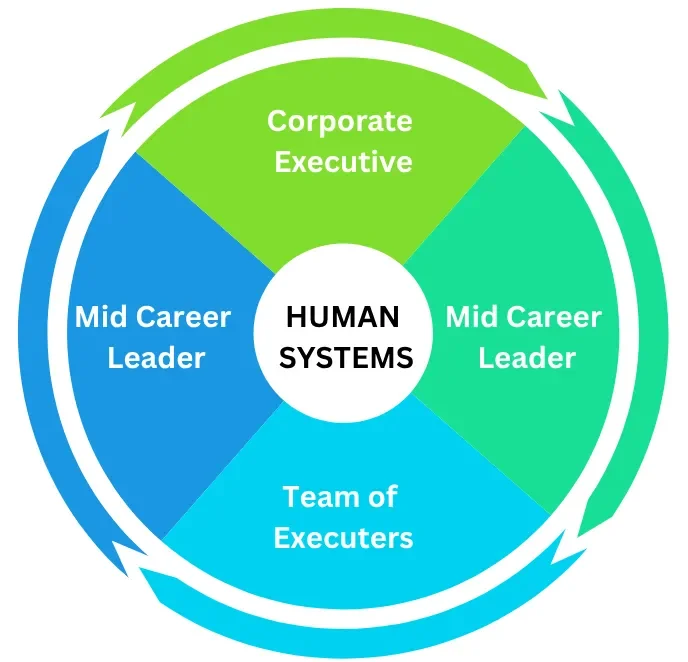
As you can see, while corporate executives typically have the most influence over how human systems are intentionally (or unintentionally) designed, the mid-career leader is the most active in the cycle, serving as the liaison between the top and the bottom.
The input and the output. The design and the execution. The expectation and the delivery.
You get the point.
Mid-career leaders are often stuck, as their name implies, in the middle. Their time is filled trying to navigate keeping executives happy while also keeping employees motivated and on track. They operate with a lack of information from both ends and a definite lack of training on how to manage the intricacies of their unique space in the middle.
Additionally, they struggle because they are operating inside systems they don’t control, while being held accountable as if they do.
How does this show up?
They were promoted because they were excellent at execution – their value came from what they produced.
Now, however, their success is measured by what their team produces. But that shift isn’t clean, and when pressure rises or performance dips, they default back to doing – stepping in, fixing, executing – because it’s what they know works. Over time, this creates confusion around their role, limits their ability to truly lead, and takes opportunities away from their team to grow.
They are responsible for outcomes, without full authority to shape them.
Mid-career leaders typically own team performance, delivery, and morale, but they don’t control the inputs like headcount, priorities, timelines, or resources. Sometimes, they don’t even get a clean read from their leaders about what those inputs even are. So, they are constantly navigating trade-offs they didn’t choose and are expected to deliver results inside constraints they didn’t design. This often leads to overcompensation: working more, carrying more, and holding responsibility that isn’t fully theirs.
They are translating strategy without full clarity themselves.
Mid-career leaders typically sit between executive vision and team execution, and are expected to make strategy actionable. However, by nature, strategy is usually incomplete, shifting, or lacks context.
So mid-career leaders fill in the gaps. They interpret. They decide what matters. And then they are held accountable for how that interpretation lands — creating a constant undercurrent of second-guessing, self-doubt, and feelings of disconnection from both senior leadership and direct reports.
They are managing in all directions, without a system for how to do it well.
Mid-career leaders spend a good portion of their time managing down, supporting and developing their teams. But, if successful, they also put a lot of their resources towards managing up and aligning with leadership – often without full transparency.
Not to mention time spent managing across teams, including navigating peers with competing and complex priorities who are also struggling to make their way along the human systems cycle.
Each direction requires a different approach, but most leaders were never taught how to adjust their communication, influence, and decision-making accordingly. So, misalignment builds quietly – until it’s practically shouting.
They are expected to create clarity in environments where none exists.
Mid-career leaders are the ones their teams turn to for answers, even though they often don’t have them. So, they create clarity where they can, make decisions with partial information, and carry the cognitive load of everything that hasn’t yet been decided. Over time, this pressure doesn’t just impact performance, it erodes confidence in their own leadership and abilities.
If you think this might be you, I urge you to ask yourself one question:
Have you ever sat in a meeting thinking, “this isn’t going to work,” only to spend the next several weeks executing it anyway?
If so, you might be a mid-career leader. And you might need some help navigating your position successfully.
And to all of you mid-career leaders out there – I see you. I am you.
I took myself off the corporate human system hamster wheel, and I’m using what I’ve learned in leadership over the last two decades to help more driven individuals and organizations find success through humanism.
And, while corporate executives typically have the most direct impact on how human systems are designed (intentionally or not), it’s the mid-career leaders who have the most influence on how the human beings at an organization experience those human systems.
Mid-career leaders: you have more influence than you think.
There’s discomfort in the messy middle. The elbows on the armrest on both sides of the airplane middle seat. The stress of being in midlife and questioning both what’s behind you and what’s in store. The frustration of the middle child who feels unseen squeezed between two siblings.
But large-scale studies on birth order show that middle children tend to score higher in traits like cooperation, honesty, and adaptability.
So, if you want to move up in the business world, contribute to a company’s growth and development, or transform an organization, lean into your time in the messy middle.
The middle is where the skills of humanisms flourish. The middle is where we take human systems – broken or not – and do what we can to cast a spotlight up, down, and all around.
The middle is where humanism thrives or dies. Which will you choose?
