The Idiot or Asshole Conundrum
It’s not lost on me that “Asshole or Idiot” is another acronym for AI.
Once upon a time, I believed that a person could get away with being either an idiot or an asshole.
Think about it:
That person you work with who is unpleasant, a total know-it-all, and often short tempered, but they are, like, really good at their job?
We look the other way when it comes to minor things like their personality or ability to play nicely with others.
Or that other colleague – the one who always needs a little extra explanation, makes minor executional errors, and is typically a half-step behind the rest of the group? But they are, like, really fun, a real value-add to company culture.
With them, we look in the OTHER direction when it comes to minor things like their ability to actually do their job well.
No one sets out to build a workforce this way. No one says that we will be a-ok as long as our talent is only halfway lacking. It’s just sort of human nature, it’s just sort of the way that we all adapt to make it work.
But the thing that’s taken me a really long time to realize is that, well, maybe “making it work” just isn’t working – especially when being an idiot and / or an asshole are both diagnosable and fixable.
Why do we accept people not meeting expectations just because they are nice?
Why do we accept people being complete jerks just because they are effective?
I truly want to know – Which do you see more often in your workplace: high performers who are difficult to work with, or well-liked people who struggle to perform?
A few months ago, I wrote about Imposter Syndrome. About how so many times, Imposter Syndrome is a mechanism for reminding us where we stand in our knowledge and where we owe ourselves more development.
About how Imposter Syndrome often represents having AI – Authentic Integrity – and how it serves as valuable data if we choose to listen.
In my coaching practice, I work with leaders – successful, driven, thoughtful leaders – all of whom struggle with some form of Imposter Syndrome. It’s so prevalent that I’ve even developed workshops around the topic. But, for the first time, I am tying it to my theory of yesteryear, one I used to espouse to any direct report who would listen: you can get away with being either an idiot or an asshole, but you can’t get away with both.
While I still believe this is the unfortunate truth in corporate America (and maybe even just life), I also believe it doesn’t have to BE the truth. We don’t have to put up with it. There are ways to do better. And, oddly, they are similar in nature to the ways that we can use Imposter Syndrome to our advantage.
In my Imposter Syndrome workshop, I work with leaders to plot their mindset on a graph that measures their level of performance along with their level of AI (authenticity and integrity). Where they land tells us a lot about what they need to be effective.
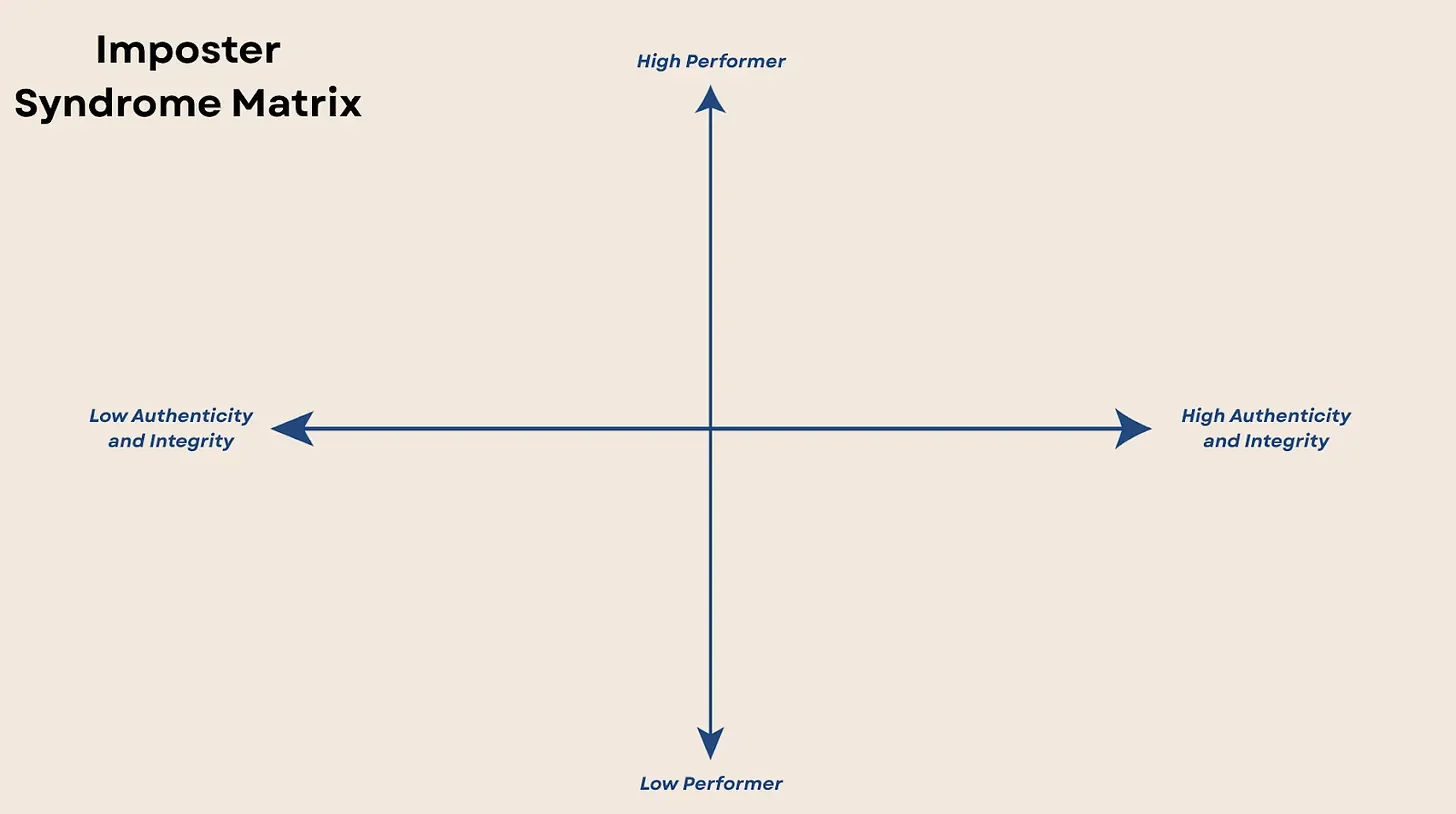
What I didn’t originally thread together is that the inverse of this matrix also tells us if a person is being, well, an idiot or an asshole.
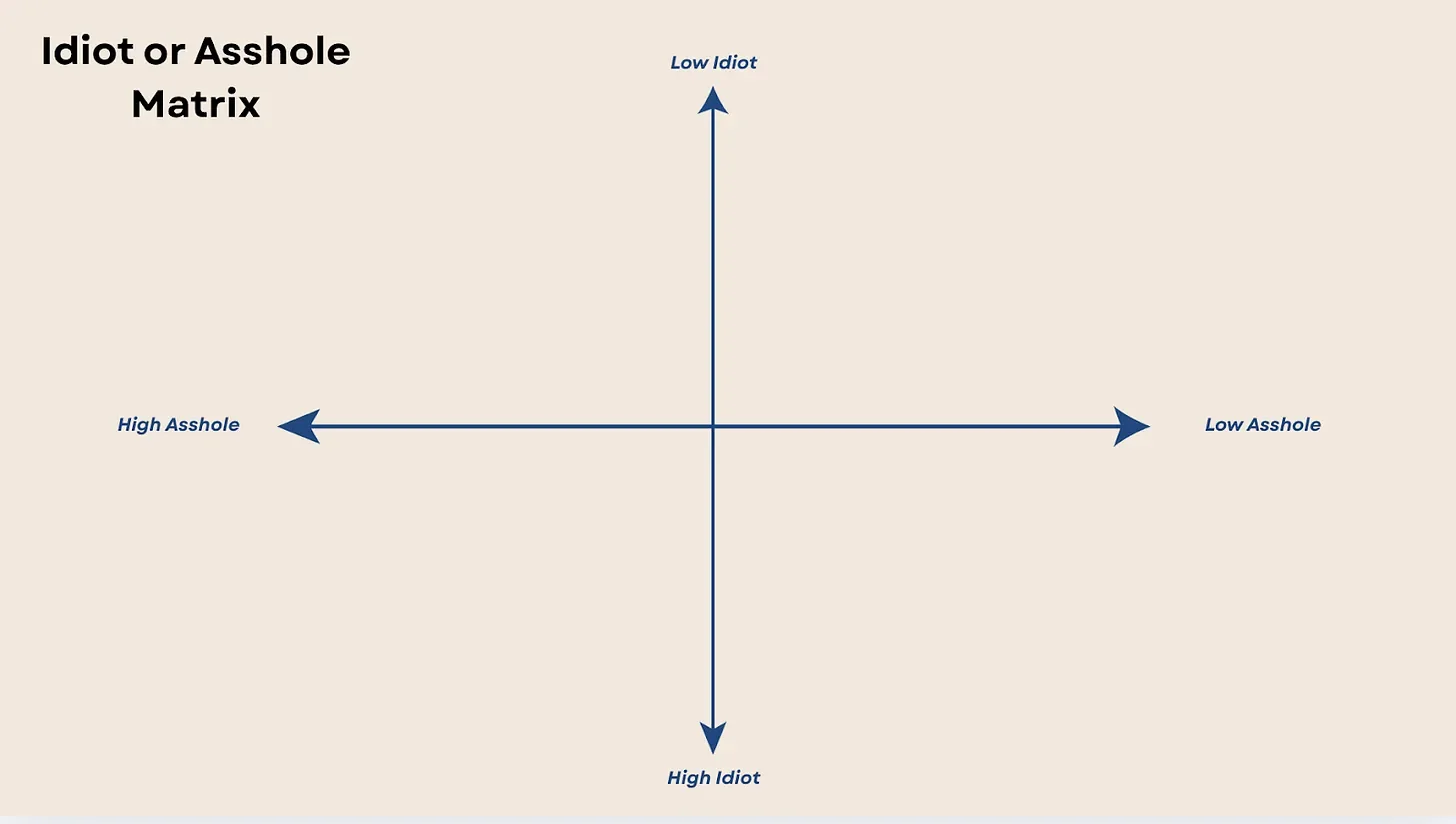
See how the graphs line up? If you’re a low idiot, you are a high performer. If you are a low asshole, you have high authenticity and integrity.
So what does this mean in terms of, oh I don’t know, leaders in a workforce?
I’ve worked with my share of assholes. I’ve worked with my share of idiots. I’ve worked with my share of assholes who are also idiots (see: Becky).
I’ve learned that we cannot change other people. We can only control ourselves, our own behavior, our own assholery and idiotisms.
We start with ourselves.
So here’s a cliff’s notes version of the work I do with leaders – whether they are addressing their Imposter Syndrome or aiming to show up as neither an asshole nor an idiot, the basics apply:
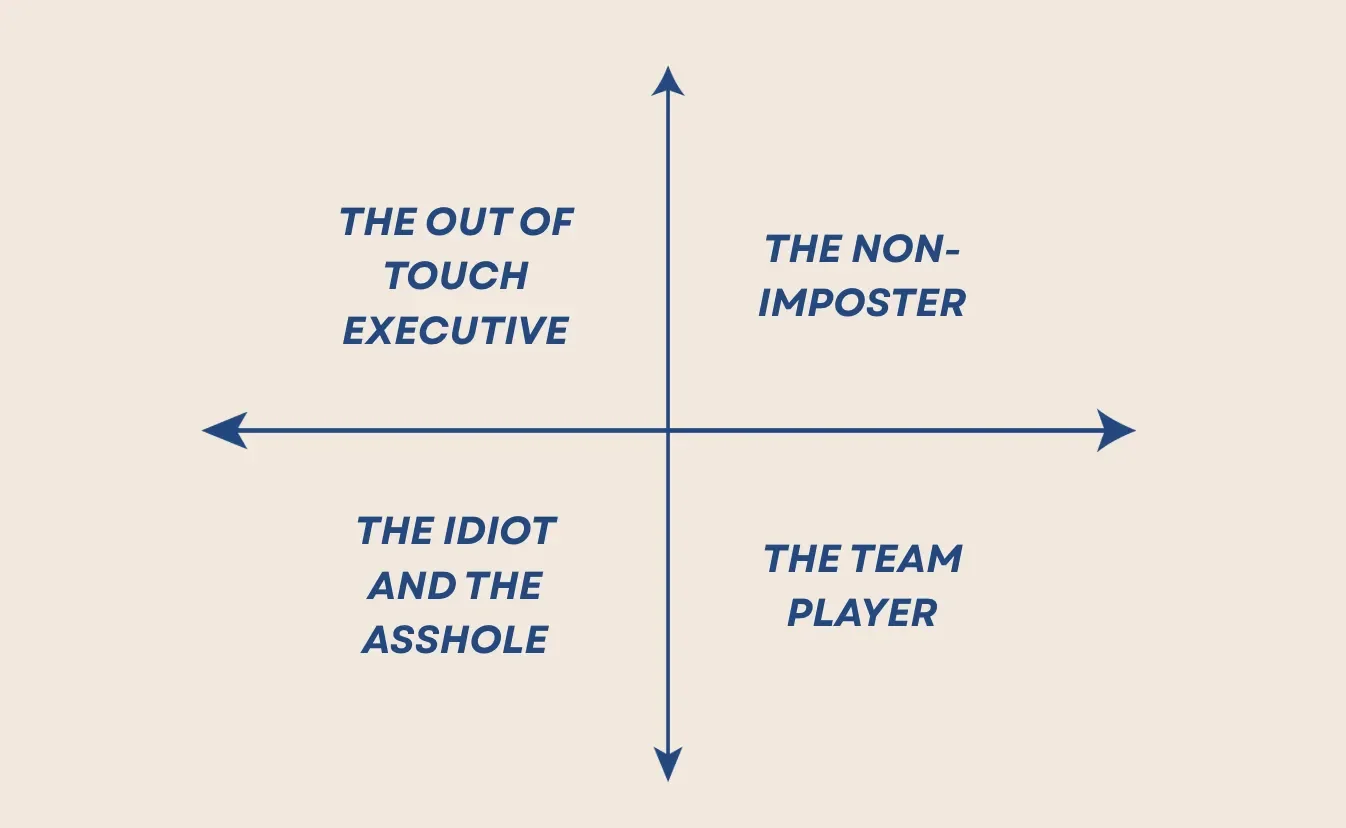
Persona 1:
High Performer (Low Idiot) + Low Authenticity / Integrity (High Asshole):
“The Out of Touch Executive”
Often highly successful but rarely self-reflective
Dismiss or ignore doubt and assume success is evidence of their correctness
Appear confident, often because they bypass internal accountability, not because they are internally grounded
The challenge: Sure, this leader might be experiencing personal “success” in a senior level position, but the fact that they operate with low authenticity and integrity does not translate to sustainable business growth. They likely move from role to role because the light from the bridges they burn is eventually brighter than their effective boardroom manipulation tactics.
The opportunity: This leader’s success is real, but fragile, built on control, speed, and confidence rather than self-awareness and trust. To drive sustainable business results, this leader needs to develop accountability within themself, seek honest feedback, and close the gap between what they say and how they lead. Without that shift, they’ll continue to achieve short-term wins while quietly undermining long-term credibility and sustainability.
Persona 2:
Low Performer (High Idiot) + Low Authenticity / Integrity (High Asshole):
“The Idiot AND the Asshole”
Misplaced confidence
Rarely feel imposter syndrome because their lack of reflection shields them from recognizing their gaps
Tend to externalize blame and perceive themselves as competent, regardless of outcomes
The challenge:This leader will often stay in place longer than they should because, though they are definitely both an idiot and an asshole, they are usually pretty good at pretending otherwise. They often have a sense of bravado that they truly believe is justified, and they are adept at fooling those around them. The key to identifying these folks is seeking data from those who are hardest to fool – this person’s direct reports.
The opportunity: Once the issue is identified (which is challenging for this type of leader), their biggest growth will come from consciously building self-awareness and basic competence at the same time — starting with accepting that their current approach isn’t working. They need to stop externalizing blame, seek unfiltered feedback (especially from direct reports), and develop the skills they’ve been overestimating. Without that shift, they won’t just stall, they’ll continue to erode trust and performance around them.
This is the most difficult kind of leadership to overcome. I have personally never seen someone like this succeed longterm, typically because they lack the self-awareness to challenge themselves in a meaningful way. They are also hesitant to seek external support and development. The first goal with this group is to help them move towards Persona 3 before they can learn to be effective.
Persona 3:
Low Performer (High Idiot) + High Authenticity / Integrity (Low Asshole):
“The Team Player”
Wants to do the right thing, but lacks confidence in their skill or readiness
Integrity Is high, but self-doubt is paralyzing
Manifests as hesitation, overthinking, and fear of disappointing others, even when they are capable
The challenge: This leader suffers from Imposter Syndrome, but has enough self-awareness to know that it’s valid. They delay decision making because they don’t feel confident, and send teams chasing their tails on work that has no material impact on furthering the business. They lack the skills, tools, and resources to effectively do their jobs and they know it – they just don’t know what to do about it.
The opportunity: Oftentimes, this leader does have real skill gaps. The difference between them and Persona 2, however, is that they know it. Where Persona 2 overestimates their ability, Persona 3 often underestimates it. Both require skill building, but Persona 3 will actually do the work.
This leader needs to stop waiting to feel ready and instead build competence through doing — prioritizing measurable improvement in a few high-impact skills, making decisions with imperfect information, and learning quickly from feedback. With the right support and structure, they can shift from hesitant to highly trusted because the foundation is already there.
Persona 4:
High Performer (Low Idiot) + High Authenticity / Integrity (Low Asshole)
“The Non-Imposter”
Feel imposter syndrome because they care
Self-doubt acts as compass nudging them toward growth, high quality work, and ethical decision making
Question themselves because they understand the stakes for people, values, and impact
The challenge: This leader struggles with Imposter Syndrome and at times it interferes with their ability to be effective. They understand the stakes of their leadership decisions and care about doing what is right for their people and their company. They regularly wonder what more they can do to grow, empower their team, and create a culture of sustainable business growth. They often reflect on their own performance and think of ways they could have done better.
The opportunity: This leader will excel once they identify – often via a 360 evaluation or multi-directional feedback – that they have the skills, tools, and resources to effectively do their jobs, then use that knowledge to calibrate self-doubt so it fuels performance instead of slowing it down.
Instead of letting Imposter Syndrome hold them back, this leader should develop systems to scale their impact in ways that match their actual capacity. Because their edge isn’t about more effort – it’s in their own internal calibration. By trusting their own judgment at the same level they question it, they unlock exponential (not just incremental) improvement for themselves and the business they support.
This is the sweet spot. This is where so many of my clients – leaders who care about improvement for themselves and the business they support – find coaching invaluable to their next stage of growth.
This, my friends, is where the work gets FUN.
So, to recap… I present The Four Personas:
We are all a work in progress. We spend our lives cycling around phases of life, career, and self. The secret to success is not in never being the imposter – or even the idiot and / or asshole. The secret is in knowing where you are at any given moment.
Then doing the work, whatever that looks like. Because there is always work to be done.
If you are leading a team and don’t know where you fall on this matrix, then you’re just guessing. And your team is paying for it.
I work with leaders to diagnose and shift this in real time. I’d love to work with you.
